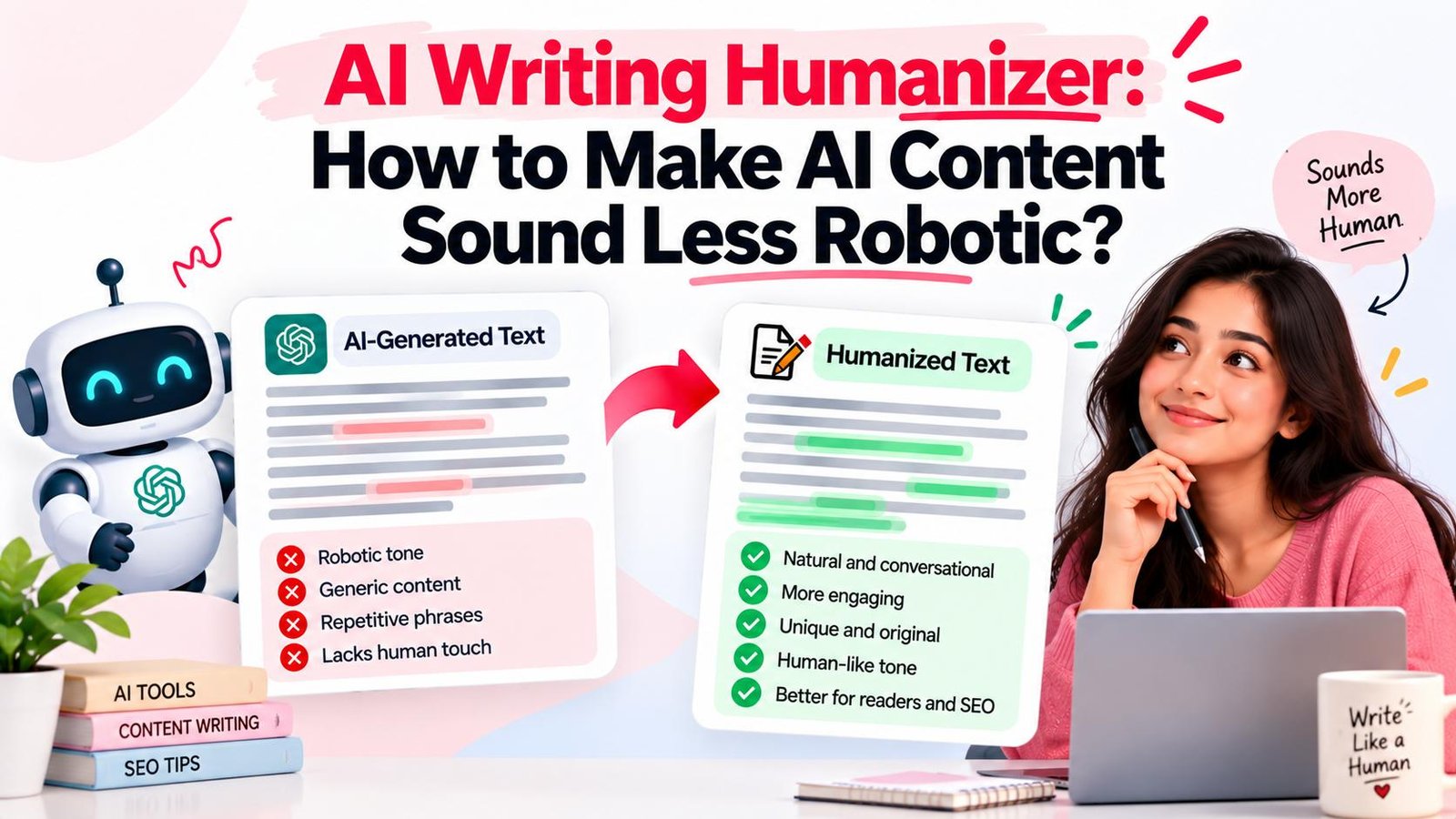
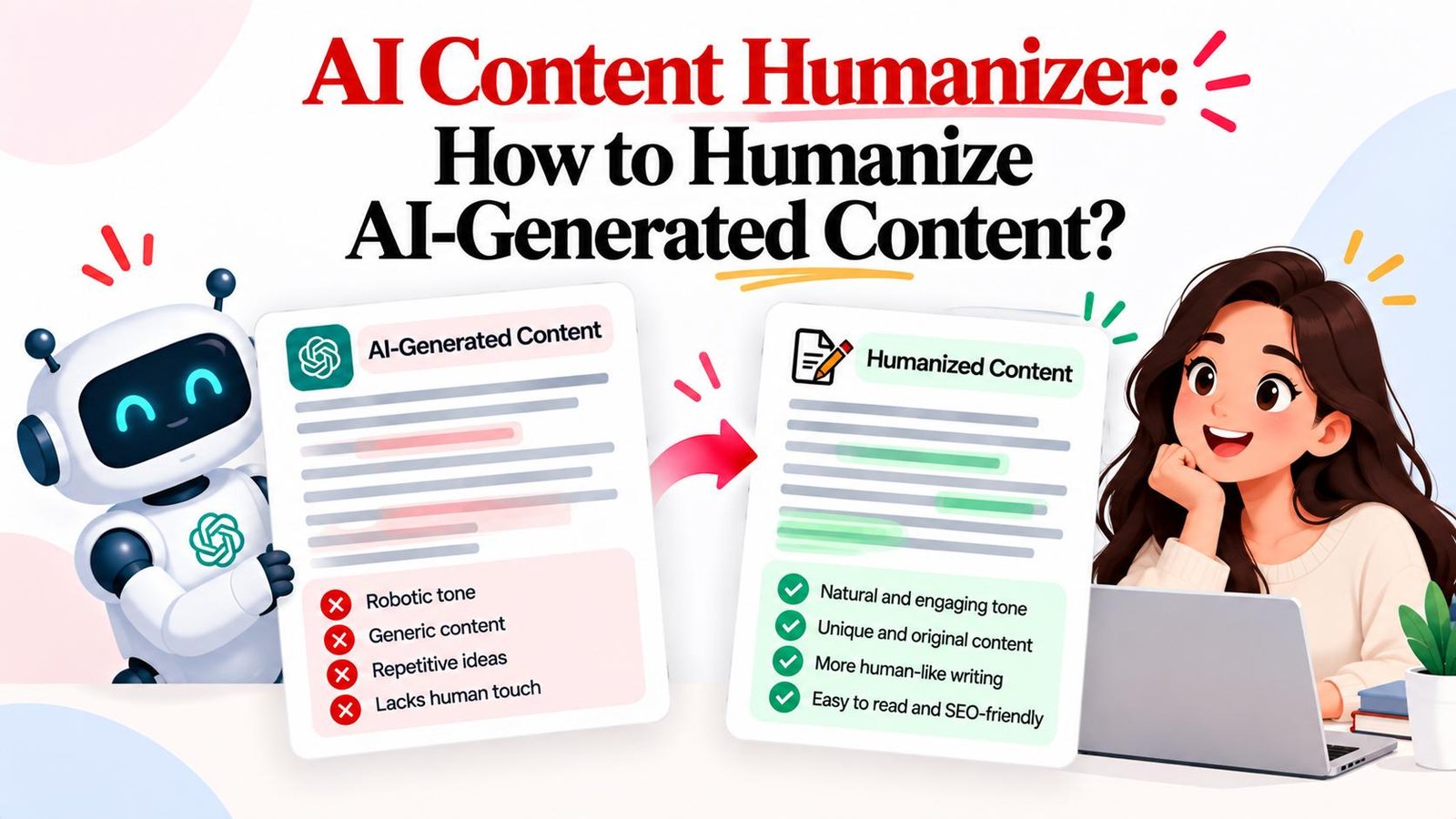
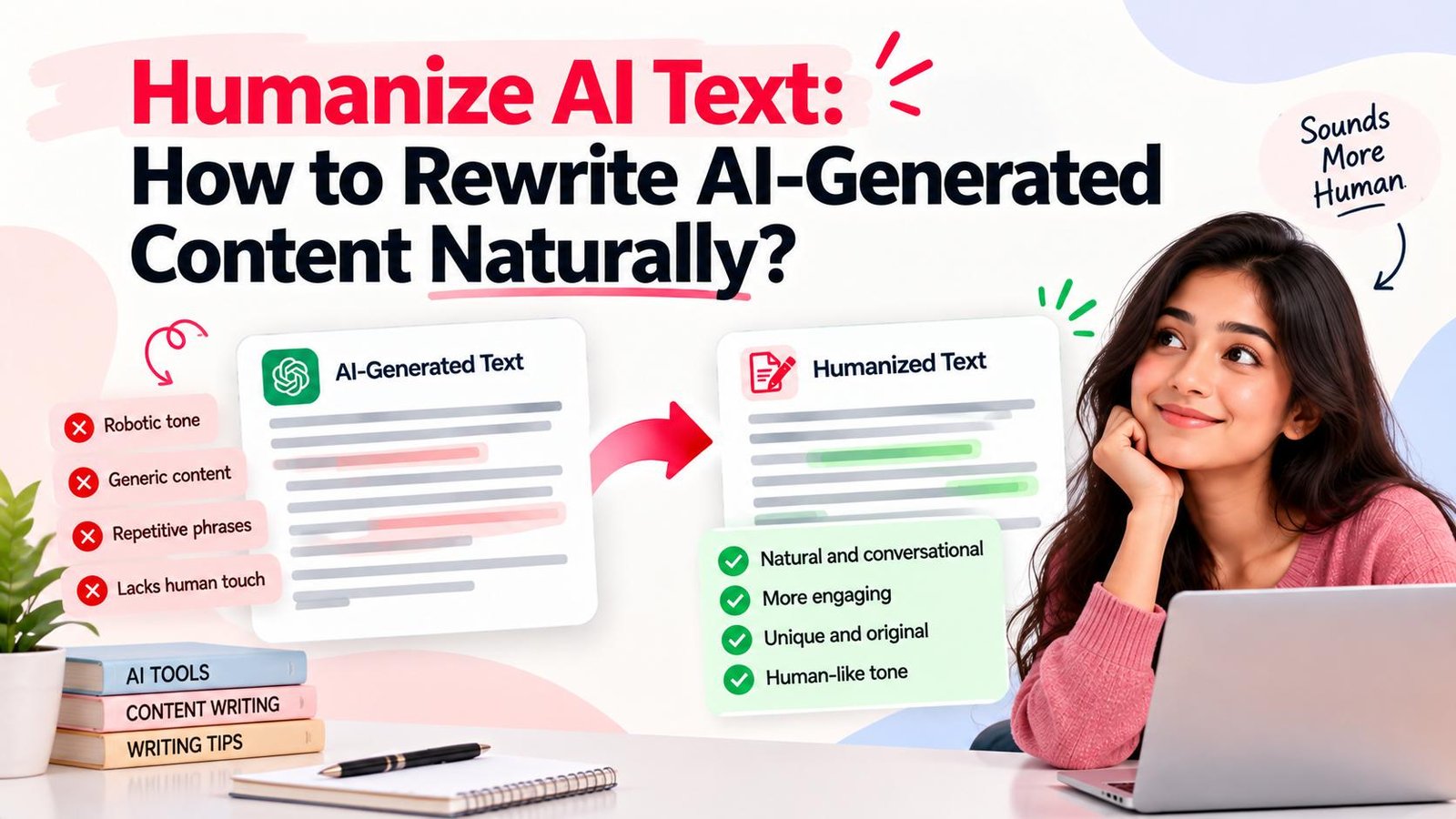
AI Text Humanizer: How to Convert AI Text Into Human-Like Writing
Looking for an AI text humanizer? Learn how to convert AI text into natural, human-like writing with step-by-step editing tips, online tools, and best practices.
Want to humanize your AI drafts automatically?
Transform robotic writing into fluent human copy in seconds.
Artificial intelligence writing assistants make content drafting faster than ever, allowing writers, marketers, and creators to generate outlines, articles, and emails in seconds. However, raw machine-generated output often sounds generic, structurally repetitive, or overly formal. When readers encounter monotonous sentence patterns and predictable phrasing, engagement drops and trust diminishes.
An AI text humanizer provides the solution. Rather than crudely swapping isolated words with thesaurus synonyms, an AI text humanizer refines clause structure, balances sentence cadence, eliminates formulaic filler, and adjusts tone so that AI-assisted writing reads naturally and authentically. Whether you polish drafts manually or use a dedicated tool like Magic Humanizer, this comprehensive guide explains how an AI text humanizer works, how to convert AI text into human-like writing, and how to maintain total factual accuracy across your publishing workflow.
Quick Answer: What Is an AI Text Humanizer?
An AI text humanizer is a tool or editing process designed to rewrite AI-generated text so that it reads more naturally. It improves wording, sentence structure, flow, tone, repetition, and readability while aiming to preserve the original message. Final results depend on source text clarity, audience context, tool capabilities, and careful human editorial review.
TL;DR
- An AI text humanizer rewrites rigid machine drafts into fluid, audience-focused prose.
- Raw AI text often exhibits uniform sentence lengths, textbook transitions, and repetitive phrasing.
- A structured 10-step editorial process simplifies dense syntax, introduces sentence burstiness, and adds domain context.
- Unlike synonym spinners, an AI text humanizer reorganizes clauses while strictly preserving original meaning.
- You can humanize text manually or accelerate the process using an online tool like Magic Humanizer.
- Generous free daily options allow users to test and refine drafts in their browser without upfront subscriptions.
- Always perform a final human review to fact-check numbers, names, and brand voice before publishing.
What Is an AI Text Humanizer?
An AI text humanizer is a specialized writing tool or editorial method designed to analyze machine-generated drafts and convert them into fluent, engaging human writing.
Large language models generate text by predicting mathematical token probabilities based on training data. While this results in grammatically correct sentences, it frequently produces predictable rhythm, clinical tone, and repetitive transitions. An AI text humanizer addresses these statistical markers by restructuring clauses, varying sentence lengths, and refining vocabulary to reflect authentic human expression.
It is essential to understand how an AI text humanizer differs from legacy article spinning:
- Synonym Replacement (Spinning): Swaps individual words with dictionary synonyms without evaluating contextual grammar, creating awkward, unreadable sentences.
- AI Text Humanization: Re-evaluates entire sentences and paragraphs, improving rhythm, balancing clause lengths (sentence burstiness), eliminating repetitive fluff, and ensuring that original facts and arguments remain intact.
When properly executed, an AI text humanizer improves word choice, sentence variation, paragraph transitions, tone alignment, and overall readability without altering your core message.
Why Use an AI Text Humanizer?
Publishing raw AI drafts can introduce friction into your communication. Here are eight practical reasons to use an AI text humanizer before sharing content with your audience:
- Improve Readability: AI drafts often lean on complex, passive structures. An AI text humanizer simplifies dense syntax, making ideas immediate and enjoyable to read.
- Reduce Repetitive Wording: Generative models frequently repeat the same central premise across paragraphs. Humanizing consolidates redundant points into clear, punchy arguments.
- Make Sentences Flow Naturally: Human writing breathes naturally, alternating between short, decisive statements and descriptive explanations. Humanizing restores this natural musicality.
- Adjust the Tone: Default AI writing often adopts a detached, overly formal corporate voice. Humanizing lets you calibrate tone to match your specific readers.
- Make AI-Assisted Drafts Easier to Edit: Refining raw drafts through an AI text humanizer creates cleaner prose, saving editorial teams hours of developmental editing.
- Adapt Content to a Target Audience: Different channels require different editorial registers. Humanizing ensures technical documentation remains precise while blog posts remain warm and inviting.
- Improve Clarity: AI assistants tend to overuse heavy academic vocabulary where plain language is far more effective. Humanizing replaces stiff jargon with crisp, relatable wording.
- Ensure Consistent Writing Style: Humanizing aligns vocabulary and framing across team members to maintain a cohesive brand voice.
Why Can AI Text Sound Less Natural?
Not all AI writing sounds unnatural; well-crafted prompts with clear constraints can produce impressive drafts. However, unedited machine output frequently displays recognizable linguistic patterns:
- Uniform Sentence Lengths: Sentences consistently hover between 18 and 24 words, creating a flat, metronomic cadence without variation.
- Predictable Transitions: Over-reliance on formal transitional phrases such as "Furthermore," "Moreover," "Additionally," and "In conclusion."
- Overly Formal Vocabulary: Frequent use of stiff words like "utilize," "delve," "paramount," and "tapestry."
- Generic Introductions: Opening paragraphs that state obvious truisms rather than answering the reader's primary question immediately.
- Repeated Conclusions: Summarizing the exact points made in preceding paragraphs without offering new insight.
- Broad Generalizations: Making high-level claims without providing concrete examples, metrics, or personal experiences.
- Excessive Explanations: Over-explaining basic concepts that an informed audience already understands.
- Lack of Specific Context: Generating theoretical overviews rather than actionable, practical guidance.
Illustrative Example of AI Writing vs Natural Prose:
- Before (Raw AI Output): "Furthermore, it is important to understand that implementing an effective strategy can significantly improve the overall quality of your content."
- After (Natural Humanized Flow): "A clear strategy can make your content more useful and effective."
As shown in this illustrative example, humanizing the text preserves the core point while eliminating pompous vocabulary and mechanical phrasing.
How to Humanize AI Text
To transform synthetic AI drafts into natural, engaging prose, follow this comprehensive 10-step editorial workflow:
- Understand the Original Message: Define the primary goal of the piece—answering a query, teaching a skill, or driving action—so your edits remain focused.
- Identify the Target Audience: Adapt vocabulary, tone, and examples to the reader's technical familiarity and expectations.
- Remove Repetition: Delete or combine repeated information, circular arguments, and filler sentences that add length without value.
- Simplify Formal Language: Replace words like "utilize" with "use", "delve into" with "explore", and "facilitate" with "help".
- Vary Sentence Structure (Burstiness): Mix short statements (4–8 words) with medium explanations and occasional descriptive clauses to mirror human speech.
- Improve Transitions: Replace textbook connectors ("Moreover," "In conclusion") with natural contextual links or direct topic transitions.
- Add Useful Context: Ground high-level summaries with real-world examples, relevant numbers, and practical steps.
- Adjust the Tone: Calibrate the voice—whether conversational, professional, educational, or empathetic—using active voice and natural phrasing.
- Review the Output: Read the complete text aloud after humanization to identify awkward phrasing, rhythm bottlenecks, or unnatural pauses.
- Fact-Check Thoroughly: Verify that dates, proper names, statistics, technical specifications, and core claims remain 100% accurate.
How to Use an AI Text Humanizer Online
When managing high-volume publishing schedules, manual sentence rewriting takes substantial time. Using an online AI text humanizer accelerates the process through a structured workflow:
- Prepare your AI text: Copy your draft from ChatGPT, Claude, Gemini, or any AI writing assistant.
- Open an online AI text humanizer: Navigate to the Magic Humanizer editor in your browser.
- Paste your text: Insert your content into the input box and review the word count.
- Start the humanization process: Click Humanize Text to process the draft through multi-pass naturalization.
- Inspect the result: Compare the rewritten output side-by-side with your original draft.
- Verify facts and meaning: Ensure numbers, dates, brand names, and procedural steps were preserved accurately.
- Make final edits: Add personal anecdotes or organization-specific insights.
- Use the finished content: Click the copy button to transfer your natural prose to your CMS or document editor.
Convert AI Text Into Human-Like Writing
Transform robotic AI-generated drafts into clear, engaging human writing in seconds with Magic Humanizer.
Humanize AI TextAI Text Before and After Humanization
To see how an AI text humanizer refines mechanical drafts into engaging writing, examine this realistic before-and-after illustrative example focusing on remote workplace communication:
Before: AI-Generated Text (Illustrative Example)
"In the contemporary ecosystem of digital enterprise operations, asynchronous communication represents a paramount paradigm for maximizing organizational velocity. Furthermore, it is critical to recognize that implementing standardized documentation protocols facilitates the mitigation of operational bottlenecks across cross-functional teams. In conclusion, by leveraging structured asynchronous channels, enterprises can significantly elevate distributed team productivity."
After: Human-Like Version (Humanized Flow)
"Clear asynchronous communication is one of the easiest ways to keep remote teams aligned without constant meetings. When teams document project updates in a shared workspace, anyone can catch up on decisions without waiting for a scheduled call. The result? Faster progress, fewer interruptions, and less daily friction."
What Changed in This Illustrative Example?
Here is a detailed breakdown of what makes the converted version significantly more readable and engaging:
- Wording: Replaced stiff corporate buzzwords like "paramount paradigm" and "maximizing organizational velocity" with plain, conversational language.
- Sentence Structure: Replaced uniform 24-word academic clauses with dynamic cadence mixing short conclusions with practical explanations.
- Repetition: Removed the generic closing summary and focused immediately on tangible workflow benefits.
- Tone: Shifted from bureaucratic brochure text into direct, practical advice that respects the reader's time.
- Flow: Eliminated rigid transitional markers ("Furthermore," "In conclusion,") in favor of organic contextual flow.
- Meaning Preservation: The central thesis—that asynchronous documentation speeds up remote teamwork—remains completely intact and unambiguous.
What Does an AI Text Humanizer Change?
An AI text humanizer analyzes machine drafts and applies structural refinements across multiple linguistic dimensions:
- Sentence Variation: Restructures uniform sentence lengths into dynamic patterns that alternate between short and medium clauses.
- Word Choice: Replaces formal academic jargon with accessible, natural vocabulary suitable for human readers.
- Natural Phrasing: Eliminates robotic idioms and clunky syntax typical of generative model output.
- Repetition Reduction: Consolidates circular logic and deletes redundant sentences across paragraphs.
- Transition Optimization: Removes rigid connector words and builds natural conceptual bridges between ideas.
- Paragraph Flow: Balances narrative momentum so paragraphs lead smoothly into one another.
- Tone & Readability: Calibrates the voice to sound approachable, engaging, and professional across diverse publishing formats.
AI Text Humanizer vs AI to Human Converter
The terms AI text humanizer and AI to human converter often describe closely related workflows in digital publishing:
| Term | Main Focus | Typical Goal |
|---|---|---|
| AI Text Humanizer | Humanizing AI-generated text | Make AI text sound more natural, fluid, and engaging |
| AI to Human Converter | Converting/reworking AI text | Turn machine drafts into natural-sounding human content |
| Manual Editing | Human-controlled rewriting | Maximum contextual control, voice, and nuance |
In practice, whether a tool is called an AI text humanizer, an AI to human converter, or an AI to human text tool, the overarching objective remains the same: transforming synthetic drafts into reader-focused prose.
AI Text Humanizer vs Manual Editing
Understanding the tradeoffs between manual human editing and automated conversion tools helps you design an effective content workflow:
| Approach | Speed | Control | Best For | Main Limitation |
|---|---|---|---|---|
| Manual Editing | Slower | Maximum | High-stakes essays, sensitive communications, fine nuance | Time-consuming and difficult to scale |
| AI Text Humanizer | Fast (seconds) | Medium | Large-volume publishing, blog drafts, marketing copy | Requires quick human factual review |
| Combined Workflow | Fast & Thorough | High | Professional publishing, SEO articles, business reports | Requires a brief proofreading step |
A combined workflow delivers the best results: run your raw AI draft through an online tool like Magic Humanizer to handle structural heavy lifting, then spend two minutes proofreading to inject personal anecdotes and verify data.
Can You Use an AI Text Humanizer for Free?
Yes, you can use an AI text humanizer for free. Across the web, free access generally falls into several models:
- Completely Free Tools: Ad-supported utilities offering basic conversion with strict rate limits.
- Free Daily Allowance (Freemium): Platforms providing free daily scan quotas with optional paid upgrades for higher volume.
- Free Trials: Time-limited access requiring credit card registration upfront.
- Paid-Only Tools: Platforms requiring an upfront subscription before any text can be processed.
On Magic Humanizer, free access is transparent and immediately available:
- Guest Visitors: 3 free scans per day, up to 500 words per scan with no signup required.
- Free Registered Users: 5 free scans per day, up to 1,000 words per scan with a free account, plus 7-day saved history.
- Paid Monthly Plans (INR): For high-volume creators, transparent paid tiers include Basic at ₹249/mo (15k words/mo, 1,000 words/scan), Pro at ₹499/mo (50k words/mo, 2,500 words/scan), and Unlimited at ₹999/mo (unlimited words and scans).
Explore our dedicated guide on AI Humanizer Free for additional details on free usage models.
Try Free AI Text Humanization
Convert AI writing into human-like prose today with generous free daily scans. No credit card required.
Make AI Writing More NaturalHow Magic Humanizer Can Help Humanize AI Text
Magic Humanizer is a modern, browser-based web application engineered to help content writers, bloggers, SEO specialists, copywriters, and professionals transform robotic AI drafts into fluent, readable prose in seconds.
Verified Core Capabilities:
- Multi-Pass Linguistic Optimization: Analyzes predictable token sequences and restructures monotonous phrasing into dynamic human cadence.
- Synthetic Marker Elimination: Automatically identifies and removes formulaic clichés, academic filler, and repetitive connectors.
- Strict Factual Preservation: Guardrails protect numbers, dates, names, citations, and core arguments from distortion.
- Zero Anti-Expansion Bloat: Refines drafts concisely without padding word counts with artificial fluff.
- Table & Markdown Protection: Preserves bullet points, numbered lists, markdown formatting, and table structures across conversions.
- 7-Day Saved History: Registered users can review, search, and export past humanizations with automatic 7-day privacy retention.
How to Humanize AI Text With Magic Humanizer
Humanizing AI drafts using the Magic Humanizer interface requires five simple steps:
- Open Magic Humanizer: Navigate to the Magic Humanizer editor in your browser.
- Paste Your Text: Insert your AI-generated copy into the input text area.
- Click Humanize Text: Click the Humanize Text button to initiate multi-pass processing.
- Inspect the Output: Review the side-by-side comparison to see how sentence cadence, vocabulary, and transitions have been improved.
- Copy Your Text: Click the copy icon to transfer your finished natural prose to your clipboard.
Ready to humanize your AI text?
Experience fast, clean AI text naturalization with Magic Humanizer.
Try Magic HumanizerWho Can Use an AI Text Humanizer?
An AI text humanizer or AI writing humanizer is a versatile tool across a wide variety of writing and publishing disciplines:
- Bloggers: Transform rigid AI-assisted drafts into engaging, authentic articles that retain readers and foster audience loyalty. Explore our guide on AI humanizers for blogging.
- SEO Professionals: Improve dwell time and readability before publication. Learn more in our guide on AI Content and SEO and explore our AI Humanizer for SEO.
- Content Writers: Refine rough drafts, remove circular logic, and eliminate repetitive phrasing.
- Marketers: Adapt advertising copy, landing page messaging, and email campaigns using our specialized AI Content Humanizer.
- Businesses: Improve internal memos, executive summaries, and customer communications for clarity and professionalism.
- Students & Researchers: Use responsibly to improve clarity and readability of study notes and draft outlines while adhering strictly to academic integrity policies.
What Types of AI Text Can You Humanize?
You can use an AI text humanizer across virtually any form of machine-generated writing:
- Blog Posts: Educational articles, how-to guides, and listicles.
- SEO Articles: Search-optimized content targeting specific user intent.
- Website Copy: Homepage hero sections, feature blurbs, and about pages.
- Marketing Content: Sales funnels, social ads, and promotional emails.
- Product Descriptions: Ecommerce catalog copy and feature overviews.
- Emails: Client proposals, outreach notes, and newsletter issues.
- Social Media Content: LinkedIn updates, Twitter threads, and captions.
- Business Writing: Reports, executive summaries, and standard operating procedures.
- Educational Content: Course summaries, training manuals, and explanatory guides.
- ChatGPT-Generated Text: Output from conversational assistants and LLM workflows.
Can an AI Text Humanizer Change the Original Meaning?
Yes, restructuring sentences can alter nuance if not reviewed. Because an AI text humanizer reorganizes clauses and replaces stiff vocabulary, you should always conduct a brief editorial review.
When reviewing humanized text, pay close attention to:
- Statistics & Percentages: Verify that numerical data points match source material.
- Dates & Chronology: Confirm that timelines, years, and deadlines remain accurate.
- Proper Names & Entities: Check people, company names, brands, and geographic locations.
- Technical Terminology: Ensure domain-specific definitions were not overly simplified.
- Procedural Steps: Confirm that how-to guides and tutorials remain logically coherent.
- Legal & Financial Claims: Ensure compliance statements and disclaimers maintain intended scope.
Does an AI Text Humanizer Guarantee AI Detector Results?
No. An AI text humanizer does not guarantee that content will pass every AI detector or score 100% human across all tools.
Claims of "100% undetectable AI writing" are inaccurate and misleading because:
- Detection Inconsistency: Detectors like Turnitin, GPTZero, CopyLeaks, and Originality.ai use disparate scoring algorithms, frequently producing contradictory results on the exact same text. Read our analysis on why AI detectors give different results.
- Continuous Algorithm Shifts: Detection models update their classifiers regularly, causing scores to fluctuate from week to week.
- High False Positive Rates: Formal, well-structured human writing is frequently misclassified as synthetic. Learn how classifiers work in our guide to what AI writing detectors measure and AI Detector vs. AI Humanizer.
The primary goal of humanizing AI text should always be centered on clarity, natural flow, reader engagement, and genuine audience value.
Best Practices for Using an AI Text Humanizer
Follow these proven best practices to ensure high-quality results when using an AI text humanizer:
- Understand the original message before initiating edits.
- Define a clear target audience and tone of voice.
- Give every section a focused, actionable purpose.
- Remove unnecessary repetition and circular summaries.
- Simplify awkward, overly formal vocabulary.
- Vary sentence lengths to introduce natural rhythm and burstiness.
- Add useful context, relevant metrics, and real-world examples.
- Maintain the intended meaning and factual precision throughout.
- Keep the tone consistent across all headings and paragraphs.
- Fact-check important statistics, dates, and proper names.
- Review humanized output side-by-side with your original draft.
- Maintain consistent brand voice across all published pieces.
- Use AI humanizers as productivity assistants rather than replacements for human judgment.
Can You Humanize ChatGPT Text With an AI Text Humanizer?
Yes. You can easily humanize ChatGPT text using an AI text humanizer. Because ChatGPT outputs standard text, its drafts can be edited manually or processed through an AI humanizer to remove formulaic transitions, vary sentence rhythm, and calibrate tone.
For detailed walkthroughs on refining ChatGPT content, explore our specialized guides on How to Humanize ChatGPT Text, ChatGPT Humanizer Free, AI Humanizer, and Humanize AI Content.
Frequently Asked Questions About AI Text Humanizers
What is an AI text humanizer?
An AI text humanizer is a writing tool or editorial process that rewrites AI-generated text to sound natural, readable, and human-like. It improves cadence, removes synthetic clichés, and adjusts tone while preserving original meaning.
How does an AI text humanizer work?
It analyzes text patterns to detect uniform sentence lengths, restructuring clauses to inject sentence burstiness and natural vocabulary. Learn how an AI content humanizer refines whole articles for seamless reading. Learn more in our guide on how an AI humanizer works.
How do I humanize AI text?
Remove redundant repetition, simplify formal vocabulary, vary sentence lengths, add real-world context, and use Magic Humanizer for rapid cadence optimization.
How can I make AI text sound more human?
Mix short and long sentences, replace stiff corporate jargon with plain words, eliminate formulaic connectors ("Furthermore," "In conclusion"), and read drafts aloud to verify natural cadence.
Can I use an AI text humanizer online?
Yes. You can paste your text directly into the Magic Humanizer browser editor and convert it into natural prose in seconds without installing software.
Is there a free AI text humanizer?
Yes. Magic Humanizer provides 3 free daily scans (up to 500 words) for guests and 5 daily scans (up to 1,000 words) for registered users with no credit card required.
What is the difference between an AI text humanizer and an AI-to-human converter?
Both terms describe tools and workflows that restructure machine drafts into natural human prose while preserving factual integrity.
Can an AI text humanizer humanize ChatGPT text?
Yes. ChatGPT drafts can be processed through Magic Humanizer to eliminate repetitive clichés, vary sentence lengths, and adapt tone. See our guide on how to humanize ChatGPT text.
Can humanization change the original meaning?
While advanced tools use semantic preservation guardrails, structural rewrites can shift subtle nuances. Always proofread the final output to ensure facts and metrics remain accurate.
Does an AI text humanizer guarantee AI detector results?
No. AI detectors use probabilistic models that produce inconsistent scores across tools. Humanization improves natural readability rather than guaranteeing a specific detection score.
What types of content can I humanize?
You can humanize blog posts, SEO articles, website copy, marketing emails, product descriptions, social media updates, and business communications.
Is Magic Humanizer free?
Yes. Magic Humanizer offers free daily scans (3 scans/500w for guests, 5 scans/1000w for registered users), with affordable paid tiers starting at ₹249/month for higher volume.
How do I use Magic Humanizer?
Open the Magic Humanizer editor, paste your text, click "Humanize Text", review the output, and copy your finished natural text.
Final Thoughts: Converting AI Text Into Human-Like Writing
Artificial intelligence writing assistants provide powerful productivity benefits, but raw drafts often lack the rhythm, warmth, and contextual nuance that readers expect.
By following a structured humanization workflow—or letting Magic Humanizer handle the structural heavy lifting in seconds—you can produce clear, authentic writing that connects with your audience and stands out.
Ready to humanize your AI text?
Transform robotic drafts into fluent, natural human writing today with Magic Humanizer.
Try Magic Humanizer